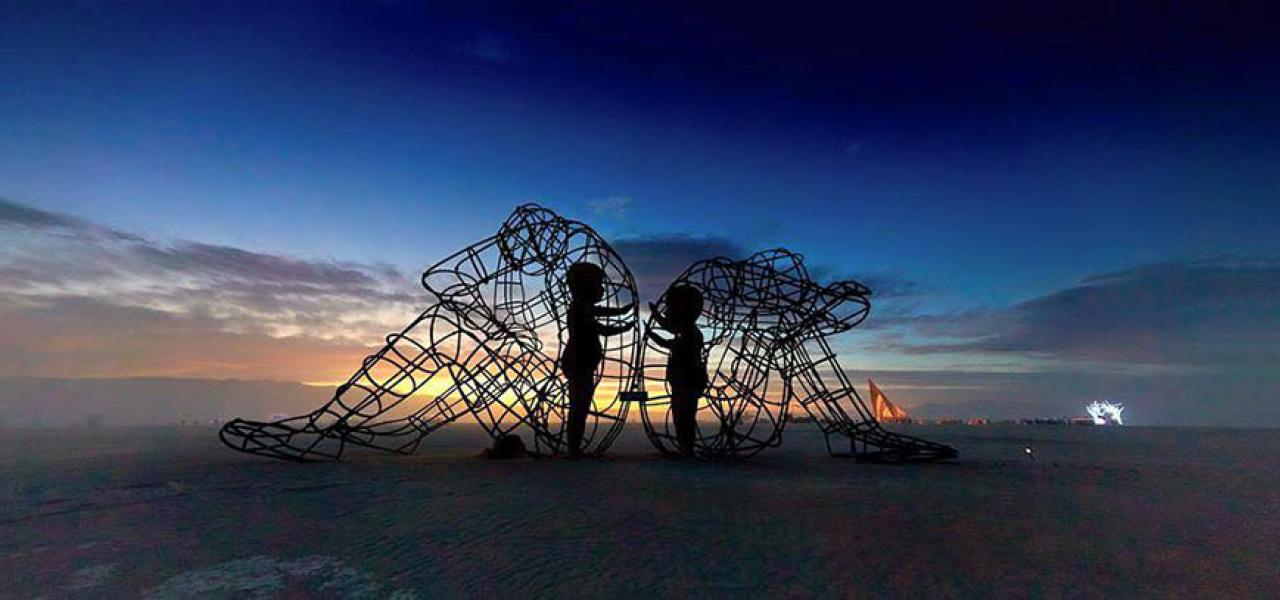
Romantic love is an emotion we are evolved to feel. It is so deeply part of us that the words of the Talking Heads song describe us well: "We are creatures of love". If we seek to understand the complex nature of the feelings we call love, we need to be aware of the majority of its construction: evolution.
Life appeared on Earth billions of years ago. At the dawn of life, the method of replicating organisms that was dominant was cloning, in which an organism replicates itself by making an exact copy. Children had only one parent from which to inherit their genes, so variation was limited. Evolution was slow, relying only on mutations in genes to cause new traits in species.
At some point, there was a change that made it possible for two organisms to come together to breed. Because of this, evolution had more flexibility; organisms could mate with each other, inheriting a mixture of genes from both parents rather than just being cloned from a single parent. This increased genetic variation, evolutionary possibility, and therefore the pace of change. Organisms with greater differences and genetic variation had, over the long run, many advantages. With faster change came more possibilities for variations that might help survival and adapt to new situations. For example, greater genetic variation within a species gave some of its members more chances of surviving a virus than cloned organisms that had identical strengths and weaknesses as each other.
In many species, distinct genders formed, such as the ancestors of the human species. This split into genders is the foundational beginning of the story of love, around which so much of our society, thoughts, dreams and culture revolves. There is a certain poetic beauty to this; we are two halves of a once united entity, split long ago in the mists of time, and bound to seek reunion forevermore.
The roles of male and female, which are common to many species, were formed way back when our ancestors were much simpler organisms. Simple mechanisms must therefore have been used for these beings to mate with each other.
We see a vast range of mating mechanisms in the diversity that is life. Our most distant gendered ancestors probably didn't even come together at first, but mated in a random way like pollen carried on the wind, or bundles of sperm and eggs drifting on the tides. However, if organisms could in some way be compelled to seek out mates, impregnation would be more direct and producing offspring would be more certain. Finding mates could be achieved by the senses being attracted to the colour, smell, shape or sound of the other sex. The more irresistible an individual finds fertile members of the opposite gender, the greater the chance their genes have of being propagated and surviving. As Dawkins said, evolution is about the survival of genes.
Choosing mates gives us a mechanism to influence evolutionary fitness. If attraction is connected to traits that give beings a greater chance of survival, such as health, size, skill at the procurement of resources, the ability to scare off rivals and predators, then again, those genes are more likely to survive. It is no coincidence that the people considered most beautiful have outward characteristics of health and reproductive fitness. There are consistencies in the rules of attraction, not only between human cultures but between species. Saying someone is attractive is, on average, another word for saying someone looks like they are in their reproductive prime.
Why does attraction sometimes feel so mysterious and magical? Attraction had to work in beings much simpler than humans, including our ancestor species, who were beings not able to make abstract choices in the same way we now can. Attraction thus cannot be a product of the human higher intellect. It is largely in the unconscious that we are compelled to members of the opposite sex who exhibit superior genetic traits. It is thus in some ways mysterious even to ourselves, and could only really be understood properly through an evolutionary lens that is historically recent.
The unconscious motivation for the male and female of our species having the desire to come together is to produce healthy offspring. Once we have found an attractive mate and produced offspring, there is still more we can do to ensure our genes' survival.
There are many different ways a species can be successful in raising children. Some species take a scattergun approach, producing tens, hundreds or even thousands of offspring, often by laying eggs, and then leaving the children to themselves. There are many parasitic reproductive species that use the nests or even bodies of other species to raise their young. In some animal communities, the children are incorporated into the parents' community; in others, children are forcibly evicted once they become adults. In some species, only the males are evicted on maturity, in others, it is the females. The style of child rearing humans use is common to many species, in which parents keep their children close to them and often eventually incorporate them into their community. In species that tend to rely more on intelligence than instinct, this allows adults to model successful survival behaviours for children. Keeping children around is not necessarily in a parent's best interests; children are generally a burden, needing care, competing for resources, risking inbreeding, attracting predators and being of little use in defence. Parents who felt a powerful compulsion to care for their children that overrode these negative aspects would raise more children to adulthood and give their genetic material more opportunity for reproduction.
The compulsion humans have towards each other is not limited to children and is felt in many of our social settings, from mates to members of our family, to friends and allies. The bonds of social connection have a hold over our minds, not unlike other compulsions like hunger or thirst, and are almost as important for the survival of our genes. Lacking an understanding of genetic evolution until historically recently, we assigned social bonds to other meanings. Religion, especially, was useful in providing answers where we lacked deeper knowledge. Enforcing social hierarchy and duties was often its primary concern. Love was so powerful and important among these social bonds that it occupied a primary place in cultural customs. We required intimate relationships to be sanctioned by God, which effectively meant our prevailing authority figures could control who we were allowed to love. Having no knowledge of love's evolutionary reality, we made up stories around it, assigning love with magical qualities, speaking of our destiny to meet "the one" who would find us via some mystical power. Our feelings of love were so misunderstood and important to us that we even went so far as to say that "God is love", a statement which says much more about human hopefulness in the face of an incomprehensible existence than anything inherent about our often cold and brutal universe. Because we imbued love with such sacred qualities, we believed love had to be uniquely human, regardless of how obvious it was that very similar things were going on around us in the non-human world. Pair bonding, child rearing, teaching, learning, and nuclear-family groups, almost nothing about human reproduction was unique to us. Love was an idea that, despite all contrary evidence, humans wanted to keep for ourselves, delusionally elevating love and thus some part of ourselves to a magical realm.
A complete description of evolutionary mating and reproduction behaviour in human beings is beyond my capabilities and beside the point here. The intent was to convince those who doubt the very deep evolutionary basis of the higher emotions humans experience. The feelings we wrap up in the word love have been felt in some way by our ancestors for hundreds of millions of years, well before there were humans, language, opposable thumbs, florists and chocolates. Humans continue to do what all animals must have done to have descendants here today: survive and reproduce. Humans, however, at some point wrapped their evolutionary behaviours in stories, often magical or pseudo-magical stories. We have covered love in an intellectual cloud that obscures our natural selves from ourselves, part of why we have a broken relationship with the rest of nature.
We are an animal exhibiting behaviours from compulsions we do not choose. We lust and love whether we wish it or not; reproduction is too important for evolution to give us much choice in this. There may be some consolation in this to those who worry about being unable to find a partner, that the isolation they feel is just their genes trying to control them and has no deep spiritual meaning. We can try not to listen to our genes bidding us to obsess about mates and reproduction; indeed, many of us might be happier if we could ignore the promptings of evolution and live individually. The lack of agency in much of mating and reproductive behaviour might also help console the heartbroken who feel a romantic partner has acted unkindly towards them. People who act badly in love are often following instincts they didn't fully choose or control. We might be annoyed that their depth of feeling and thought was not enough to override their passions, but if reproduction required advanced human levels of feeling and thought, our species would never have survived to the present. There are untold millions of flawed individuals over time who did not or could not ignore sexual weaknesses and urgings, urgings springing up from their subconscious that they ultimately didn't choose to feel. People have lost jobs, positions, marriages, friendships, family and many more things over this issue. This is a common human flaw, so common we might wonder if we should encourage more acceptance of the tolerable forms of sexual impropriety for the sake of social cohesion. Certainly, fighting against what are perfectly natural urges seems rarely to have worked, even though cultures and religions have been trying to control sexual practices for thousands of years. This will continue to hurt people until we can all be more faithful, less jealous or more honest about who we are.
So is this what being in love is, conforming to the conspiracies of the genes?
Thus, I get to the reason I wrote this: to think about what love means beyond this.
I shall start with that which I sometimes feel quite piercingly, the isolation of consciousness.
I can communicate my thoughts to others in many ways. I can speak, paint, play an instrument, write a treatise on love, but they are only the reflections of my thoughts, not my actual thoughts themselves. We feel in streams of emotion, which are then imperfectly translated into segmented words. Our imperfect communications are then put through the filters of other people's expectations, assumptions, and conceptions, a process which, by the end, sometimes makes the thoughts that end up in other minds almost unrecognisable from those which we thought we were expressing. We are all full of assumptions about others based on our limited experience, many incorrect, but it is much simpler to deal with people in the world that way. Among the superpowers of our minds is pattern matching and remembering, so we can use our past experiences to help navigate the future. For all the flaws in this process, it is infinitely better than navigating the world as if we had never experienced or learnt anything before. We put others in boxes perhaps even more so than people did in the past because of the number of people we meet in modern cities. This simplifies decision-making and often protects us from repeated mistakes or missed opportunities, but it robs other people of their individuality. People will treat you according to their own experiences, because other people are something of a black box to us, especially new people; unfortunately, on average this will mean bad people tend to get treated better than they deserve and good people worse. Personally, my intentions are misunderstood regularly and I expect others have the same experiences even with people who know them well.
Our thoughts and senses being hidden within us mean misunderstandings are inevitable to some degree, we don't feel each other's emotions and only get an imperfect reflection of their true self. There is some comfort in this private, un-intrudable place within ourselves, but there is also an inherent loneliness to it. With time and introspection, I can see how all things in the universe are one form, part of a great process where things are no more separate than waves from the ocean. I can see this about my body, made as it is of the same chemicals that make up all the stars and planets. It is harder, however, to integrate my thoughts, the centre of my conscious self, into that totality, they seem somehow irrevocably separate from it.
The only way I can see to really overcome this is by doing our best not to take our assumptions about others too seriously, that it is inevitable for us to misunderstand them in some deep ways, and we must try to rest comfortably in the knowledge that there will always be some mystery to each person. This is not to give up of course, we should not abandon the depths of others, nor should we not try to bring others into the depths of our own private world through open communication. We must try to ignore our snap judgments for a deeper, patiently built picture of each other, as we hope they will do for us. Through time, we hope others can begin to move us out of their generalised boxes into our own personal space in their mind, a shape that is ours alone. Over time they can build a more complete picture of the true self within us, and see a part of the unique individual we have the potential to be inside us. Hopefully, others can come to see us in positive or constructive ways we don't see ourselves. I am sure I am not alone in meeting many people in my life who seemed not to hold themselves with the high regard I felt they deserved.
Of course, in presenting ourselves to others and the world there seem to be many possibilities. As William James said, we have as many selves as we have social relations. Which of the many facets of ourselves is it that we want others to see when they look at us? Who we are or who we would like others to think we are? It perhaps isn't wise to give strangers or unkind people the same depth of ourselves, but we should be careful in thinking about who we owe honesty to and how much. Others who know us well we certainly owe more too, and in revealing ourselves to them they have a unique position in helping us to our aspirational self. The hardest person sometimes to judge is ourselves, and thus to learn and grow in life, to reflect, experience and learn, our deeper relationships can be our greatest tools.
None of these benefits of a close relationship is particularly unique to a romantic liaison, but in my experience, they can reach their deepest expression within it. I think in a romantic relationship, the physical closeness can be conducive to an intensity that opens the possibility of greater emotional union. We enjoy sharing similar positive emotions between ourselves, going through the same emotions together assuages our isolation, and becomes even more intense when mixed with the evolutionary drives and pleasures of sexuality. The privacy of this relationship, the intimacy and intensity of time spent together, is often greater than in other relationships in our lives. For reasons based on an evolutionary drive to find a mate and bond with them, as I discussed earlier, we feel a connection with each other that can be the most intense of any relationship. This can be the closest we get to bringing the other into ourselves, of finding and merging with that other half we lost so long ago in evolutionary time. We can become so caught up in our interactions, so intent on each other and ourselves in one moment, that the line between us is blurred and we find our long-lost union.
The fairytales tell us romantic love is pure and perfect, but like most things in life, it has many sides to it. It can encompass both pain and pleasure, possession and freedom, selfishness and selflessness, safety and vulnerability, even hatred. It is often felt more like a compulsion, a chain, a wave, a deep emotional and physical need, rather than something purely positive and uplifting. In capturing us so wholly and deeply, sometimes despite our best interests, wounds that stem from relationships are often the longest we endure and the hardest to heal. We have let another into the most private and personal part of ourselves, we have bared our soul and any negativity they do to us is amplified as a rejection of our whole self. We can try to find healing in the knowledge that millions of years of evolution is the reason for our sadness and longing, though often rationality in such moments is of little solace. When we enter into close personal relationships with others, we are writing part of the story of each other's lives. We may always reflect upon whether we wish it or not. This place of importance places a heavy burden on us. We are driven to love and lust so effortlessly, so thoughtlessly, rarely for one moment fully comprehending the dark and ancient power we wield over others. True love requires an honesty and selflessness that challenges all but the few who have somehow maintained an emotional purity despite an often broken world. Sadly, it is perhaps beyond the character of many.
Romantic love of any truth should improve our experience of existence. To fill our lives with as much happiness as possible, deep romantic liaisons between people who have each other's best interests at heart offer endless opportunities for physical and psychological pleasure. I don't agree with the idea that there is one true love that must be eternal, and think it is counter-productive. This idea can make us hold something up to an impossible standard, to try to force something to be what it can never be, and miss the beauty of what we actually have. Worse, we can fool ourselves into thinking we have something we do not have. Inevitably, reality will collide with this delusion. It can even motivate us to lie to each other, to tell people what they want to hear, to feed them cliches from movies, books and songs, rather than communicating what is truly in ourselves with all the possibility for growth that entails. True eternal love is a romantic notion, of course, an ideal most of us seek, but in reality, we can never offer each other that guarantee, only that we will sincerely try. Though people sometimes are compelled by their minds to confess love immediately, I, like many, have blurted it out in a moment of passion. The reality is that it takes a long time to even begin to get a conception of another human being, and this must also acknowledge that we are all changing as we live. If we have not spent significant time in someone's company, certainly months but possibly years, it would seem to cheapen the word love to use it with so little true connection. We can and will have glimpses of eternity in moments, but they are no less beautiful if we acknowledge they may be fleeting when we accept them for what they are. The fact that all things must pass does not rob the world of beauty; it makes the moments of experience rarer and more precious.
So that is some part of what love is about to me, but I don't pretend to speak for all. If we were to define romantic love for others, we would need to encompass all of that which we see around us that masquerades under that term. The love of teenagers who ridiculously assume their first love will be forever, the love of the person who is really just suffering at the hands of a selfish abuser, the abuser who speaks the words of love and perhaps even thinks they feel it, the shallow love of a person resigned to never having the partner they really wanted, the love of a person incapable of deep thought who buys the cliched gifts on the cliched days whilst expressing cliches, the love of a those who will at the end of their life realise that they never really knew love or perhaps too late realised they were too selfish to be capable of it. These are expressions of evolutionary love, following the same unconscious drives that send the salmon battling upstream, that lure the insect to be its mate's dinner, that bring the flocks, schools, dancers and herds to the same places every year to display and hopefully find a partner with which to mate. If these things are what we call love, this poor, overused, downtrodden word, perhaps we should speak of something beyond it.
The evolutionary aspects of love are instinctive, unspoken, emotionally intense, and we should desire this in its fullness, but as intellectual beings, we have the almost magical possibility for something deeper; we should feel driven to push at the edge of the envelope of what love can be. Something that fulfils the needs of a thinking ape, descended from a single-celled organism, who has evolved this complex consciousness that knows both its separateness from and connections with the universe around it, its place as an individual, meaningful, creative being, yet does not always know how to fully deal with that knowledge.
Sharing deep emotional and physical experiences with others can help us to explore our consciousness, to expand our consciousness and sometimes be a shield from that consciousness. Love is a way to seek pleasure, solace, companionship, beauty, truth, stimulation, healing, and experience the deep reflected joy in returning those things. In the reflection of another's love, we can be truly seen, not unshielded and alone in our journey through time.
Love may simply be something we are evolved to feel, but that does not rob it of magic. To live and not experience love for some other sentient being capable of reflecting it back into our eyes would be to have missed out on part of the deep beauty of existence. In this often unfair and even cruel universe, in which the sensitive soul can feel lost, drowning amid the waves of negative thoughts and emotions, finding love can be like someone grasping onto our hand from above the waves and pulling us back to the surface to breathe. For those of us who the world has slightly broken, to bask in another's love can be to experience ourselves as we might have been if we had experienced a kinder world, to help us heal and find that person within ourselves.
The deepest expression of love is a moment as close to union with both each other and the universe as we can be. Although we feel and perceive everything in existence as being separate, in a turn of mind we can also come to realise that all is one. As the deepest expression of that realisation, of our interdependence, maybe love can save us.