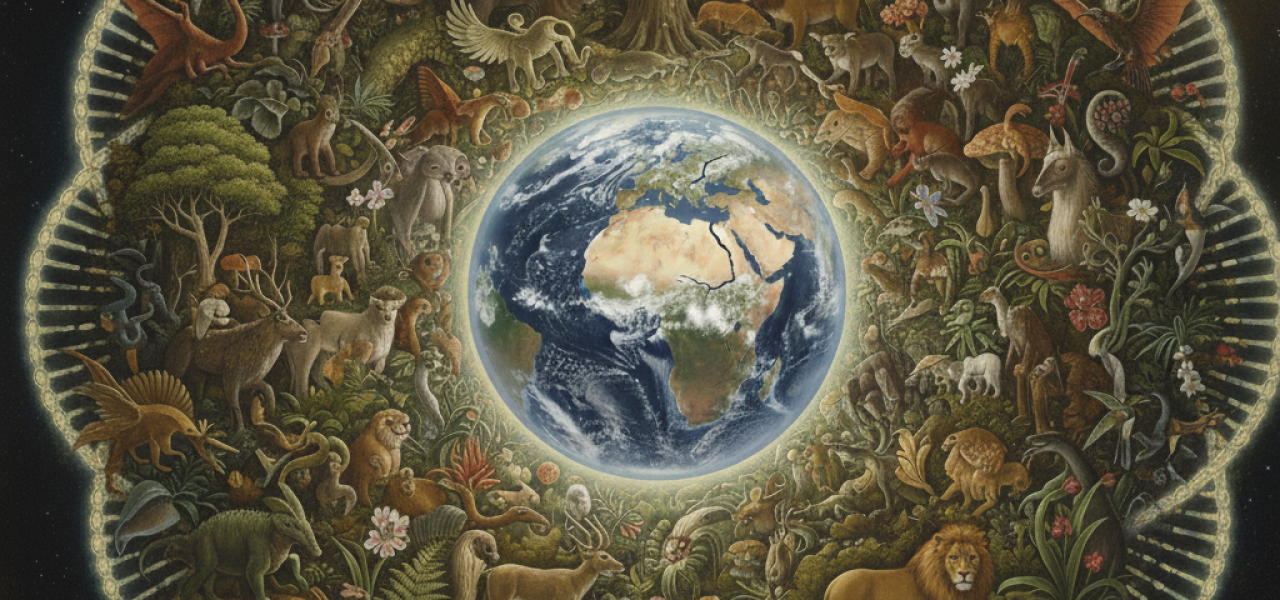
We exist within an evolutionary reality; it is hard to overstate the significance of this fact. It is important to understand what we are to help us become what we can be.
Every facet of the being that is comprehending these words is the result of billions of years of the evolutionary process. You are the direct result of a "successful" line of ancestors stretching back at least a billion years, a line that started out with the simplest possible organisms, and now comes to you: an individual capable of intricate creation. This is not to say there was necessarily a linear progression between these two points; it is a misunderstanding to view evolution that way. The ability to fly is discarded if unused; creatures have crawled from the sea to live on the land and then walked back to live in the sea again; the human brain is now smaller than it once was. Chance too comes into play: a comet hitting the Earth may wipe out all the "fittest" species, leaving the things that previously survived by huddling in fear to emerge from their burrows and hiding places, and become the dominant species in a newly recreated world. Evolution is a process that appears to move in certain directions, but this is governed by chance interacting with the laws of physics. Evolution is written in the language of the universe, and that language, as Galileo said, is mathematical rather than philosophical. Evolution cannot care about who is the strongest or fastest; it is just a word for the unfolding of who survives and reproduces.
Humans tend to think in terms of stories with comprehensible narratives. We struggle with the idea that there is no point to evolution, or that there is no morality inherent in the cosmos. We are creatures whose minds yearn to find patterns amidst the masses of information circling around us, patterns that make sense to us in an ordered cause-and-effect way. There are patterns around us, but there is just as much chaos, and we do not know how to deal with this. We cannot change the cosmos, so we have tried to construct patterns of thought that contradict chaos in both our religious and secular ideologies. We are drawn to narratives that make us feel that we live in a cosmos that is logically ordered around a central meaning, and we would like that meaning to be us. This is a cosmic delusion, an unnecessary one. Our choices are not only between a fabricated meaning to make ourselves feel better or a life devoid of meaning; there is a truer way.
Everything with which we view and understand the world is the result of evolutionary processes. Our senses, the brain which connects those senses to make a coherent picture of the world, that remembers and looks for patterns, and the body which reacts to our brains and senses, while allowing us to manipulate the environment, all of this is evolution. In looking outwards, we cannot escape the frame of evolution because it is the fundamental basis of our being. There simply is no other reference point, no other place to ponder ourselves from than an evolutionarily based organism within a system of living things that are also products of an evolutionary system. It is hard to overstate how much we live and think within an evolutionary reality.
To try and escape this reality, which has us grounded in the realm of life, to find some realm of pure reason grounded in nothing but our thoughts, is both highly unlikely and, I believe, an errant attempt to locate meaning only in the mirror of ourselves. Just as a sense only has a purpose in relation to other things, the mind, too, only makes sense in relation to the reality in which it evolved as a response. We understand the limits of pure reason, hence why we must temper even well-intended thought with the scientific method or empiricism. Truth is often counterintuitive, unknowable, or beyond our comprehension. This is not to say we should relegate reason to a subordinate position in understanding ourselves and our environment, merely that we should look for confirmation of the ideas of reason in our lived experience and within the evolutionary realm that defines us. Reason, for instance, might lead us to believe that we have no free will because everything about us is shaped by our genetics and environment. Our lived experience, however, is very different; we live our lives apparently making choices that create different outcomes. The reconciliation of the lived experience of free will and the logical reasoning that says free will is an illusion is not to elevate one form of thinking or the other, but to rest in the knowledge that both are important truths that should be factored into our considerations. To try to choose between them in some attempt to be consistent or certain in our thinking is a greater fallacy than to accept two seemingly contradictory positions. Antimony is a word that expresses that there can be competing truths that are both well-evidenced. Thoughtful doubt, weighing different positions and keeping them in mind, is often the closest to truth we can get.
Evolution is complex. The life cycles of many creatures defy belief. Much less the complexity of the interaction of all these individually complex species and beings within local or global ecosystems. How then can this system, which we know so little about, be the basis for the certainty of our intellect? Though we seem to crave certainty, it is often an unattainable illusion. In overly clinging to it, we lose grasp of the wider truths, the mystery and awe of our existence. Caution, consideration and subtlety are often the appropriate responses to the complexities of this world rather than instinctive decision or reaction.
Mute creation
Looking at the belief systems that underlie the actions of human culture, it seems clear that we are still caught up in a pre-Darwinian conception of the world and ourselves.
It is easiest to see this in the doctrines of most religions, their separation and elevation of humans as beings with "souls" and the rest of creation lumped into a subordinate morass. God may be dead, as Nietzsche declared long ago, but this conception of the ordering of the world has changed little even in the ever-expanding secular world.
Nietzsche, of course, did not kill God. If anyone could claim to have done so, it would be Charles Darwin. The theory of evolution radically reshapes the ordering of life. Humans, no longer created in anyone's image, are just a significant point in an ongoing story. Science may have separated us further from other animals physically, but the philosophical ramifications of what science has learned about our relationship to all other life should be to draw us closer to them, to see how much we share with them. With the absence of a divinely created soul that elevates humans beyond all comparison with other creatures, each being instead becomes a collection of physical and intellectual characteristics that it is possible to compare. Humans are many things at once: we are cosmic entities, living beings, animals, mammals, apes, and specifically, great apes. We share aspects of ourselves, more or less, with all these categories. As we get further along this spectrum, we can look at the anatomies and intellects of other species to see how much we share. Humans are an instance of a very ancient and wide evolutionary pattern, and this gives us a window into other beings. We know something of the joys and sorrows of other beings because we share so many commonalities. There are many differences between species as well, but it is clear that a basic empathy with the mental world of other species is not anthropomorphism but rather is in concordance with the tenets of modern science. We can see the similarities in our bodies, the threads of the nervous system connected to the same parts of the brain, the sensations of the senses, the spectrum of emotions. With the "higher" species, we can understand their abilities to think, to judge fairness, to learn, to bond together, even to love. The more we learn, the deeper we become, the more we understand that humans exist with many fellow travellers on this journey of consciousness, and they deserve a primary place in our consideration.
The argument for a change in our treatment of "higher" species is, I believe, clear and unassailable. Only self-interest and custom have stopped its progression once the mythology of human divinity was unmasked. A world in which we are the highest consciousness places a much greater importance and responsibility on us. As the most powerful species, we have a duty towards others that may share similar suffering to our own, but currently lack the intellectual tools to mitigate it.
We should have no hesitation in calling the current epoch the Anthropocene. This is not to indulge in the hubris that humanity is in total control of all things. There are many natural forces we are powerless in the face of. What defines this epoch in the world's natural history is the ever-present fingerprint of humanity. In some ways, we are like a natural disaster that has befallen other life. The trail of extinction that has followed the rise of humanity is on a scale that we can only compare to things like comets hitting the Earth and supervolcanoes erupting. There is nothing fated about this as human destiny, however.
As humanity progresses morally and intellectually, many individuals are opening their eyes to this reality. They realise they wish to be a creative rather than destructive force in the story of life. Destructiveness is not written into our DNA. Not only can we be something different, but many individuals are showing a path to this new version of ourselves. The wisdom underlying this progress is knowledge and respect for evolution.
Evolutionism
Life is an ancient, mysterious force, process, spark we will never fully understand. As the earth spun billions of times beneath the energy of the sun, our ongoing creation story unfolded: the process of evolution. Amid the flow and dance of matter over these countless moments evolved the scarcely comprehensible abundance of life that inhabits Earth. To understand even a part of this is to be awed by it.
All life shares a spark, an evolutionary essence. We can look at every living thing around us, knowing that at some point our ancestors shared a similar level of intellectual complexity. Though our senses exaggerate our separateness, our deeper understanding calls to our relationship with all things.
Consciousness, a form of evolutionary adaptation dependent on genetic change, but also able to transcend it, became more subtle and complex. Eventually, a class of hominids with a new, more complex sort of thought started to appear. The Neanderthals, the Denisovans, we Homo Sapiens and many other human species whose traces we can see in our DNA.
Among these many hominids, only Homo Sapiens, we modern humans, survived to the present era. Opening our eyes to the world naked and alone, able to ask questions of the cosmos around us in ways deeper than had ever hitherto been asked. We share so much with the other complex life which surrounds us; a pattern-seeking mind utilising data from sight, smell, touch, taste, and the ability to feel pain and pleasure. But also, there is something else, something within us almost as magical as the original spark of life itself. It has been described as the universe evolving the ability to know itself. A consciousness that can ask itself questions like “Why am I here?” and “What does this all mean?”
Some questions we may never answer fully, but other questions we are simply not ready, either individually or as a culture, to answer. To begin the process of even partially answering the fundamental questions of our existence would require long, incremental, sometimes patchy progress in advancing our thinking and comprehension. Many of the ideas we take for granted today required the participation of thousands of previous thinkers to perceive. Each generation passed on incomplete insights to the next, till the puzzle pieces started to form a coherent shape.
Slowly, they unpicked many of the great mysteries of our world, the process of evolution, the structure of our universe, and the processes of our mind. Each of us still awakens naked and alone,to the universe, knowing no more than our ancestors did back into the mists of time. But now more than ever it is possible, with education and learning, to live with a reasonably rational view of the world and ourselves.
Our modern progress is of little comfort to all the thoughtful generations before us, trapped within the confines of the cultural knowledge of their time. For individuals to even partially question the thinking of the society around them, at many times in history, was dangerous or even fatal. Even without these societal impositions, however, our ideas are formed in the interaction with our environment; to completely transcend the world around us is simply too difficult an intellectual feat. Individual genius is important in pushing our knowledge forward, but individuals, even geniuses, are finite in time and space. If we cannot pass on our learnings and understandings to other minds it will be lost. In the greater story of human progress over the centuries, we can only progress together.
Generations of pattern-seeking, meaning-seeking masses looked out upon the world before modern thought and sought answers. They looked to those around them, those with greater knowledge and experience, the ancients, the elders, and other authority figures. They were easy targets for those claiming to have special knowledge, those who offered false answers. Whether these claims of special knowledge emanated from an authority figure’s mental delusions, or from a need for power, status and control, there was little ability to refute them. The false answers became institutionalised, taught by rote to impressionable children. These lies and half-truths were surrounded by song, stories, ritual and even complex philosophy. They provided much that we sought: community, identity, belonging and just enough meaning to partially sate our complex pattern-seeking minds.
Still, there was something about the human mind, based perhaps on an evolutionary advantage of dealing with the world as it is, not as we perceive it to be, to seek the truth. Through a fitful process that took the collaboration of the best of many cultures, often within the confines of religious communities that, despite themselves, encouraged literacy and learning, we finally began to understand. Newton, Darwin, Einstein and countless others had stood on the shoulders of giants and seen deeply out into the world. Now, standing on theirs and many other shoulders, we can finally glimpse something of the eternal truths we had so long sought.
Deicide
To change the world, or a person, however, is not as easy as just uncovering a truth. The institutions and culture formed over eons offered too much identity, power, status, belonging, and certainty to simply be overthrown by better ideas. We may have killed the gods, but the still relatively new, intellectually challenging ideas of science and philosophy have yet to win the war with comforting untruths and half-truths, stories developed and improved over thousands of years. We like the idea that God is love, but it is an idea that doesn't follow from looking at the world that is around us, so it must be embedded in us by countless repetitions.
What are the questions for which so many needed comforting falsehoods? There are questions of identity and purpose, ones about status, power and rules governing behaviour. All of these questions are consistent with our evolution as a communal being. Questions like how should we treat one another, what is my place in the social order, do others respect or admire me, and what should I be doing with my life? Then there are questions in which higher consciousness stares into the mirror. Why am I here? What is the reason I exist? What is the point of anything's existence? How do I handle suffering and death?
In place of religions' complete answers to the questions of meaning, modern thinking and science can only offer us incomplete answers. Fictions are, after all, far less limited in what they can claim than the truth.
Evolution, being perhaps our greatest step forward in scientific understanding, was, almost by necessity, an equally great step forward in our moral and intellectual understanding. Of course, this was not how it was seen in Darwin's time. For a long time, evolution was seen as removing meaning from life. Darwin himself said publishing his theory felt like murder. To undermine the creation stories of our holy books, in societies where the church and state were joined, was to undermine authority in all matters. Where before people could take solace in an external authority, higher than any earthly power, suddenly there was a void. Humans in all our frailty were now the highest beings; God had left us to ourselves and our squabbles. Evolution seemed to mean that now only might be made right, that to live was to participate in a war of all against all. Although Darwin tried to avoid using simple phrases like survival of the fittest, or even the word evolution itself, with "evolved" only appearing once in On the Origin of Species. The momentum towards a naive understanding of his theory was too great, with people concentrating on what it took away rather than what it gave us.
If gods don’t exist, does that mean everything is permitted? Are we destined for a morality-free void, a festival of cruelty? The curtain of religion had been thrown aside to reveal only human hands, and many advocates of religion argued for simply replacing the curtain. There had, after all, always been sections of the elite who saw religion as the opiate of the masses, not something to be believed by serious thinkers. Plato talked about a magnificent myth that the elites would propagate and pretend to believe, and the bewildered herd would slavishly accept, sustaining an elite-guided morality and social structure. An endless future based on a mythical distant past, paternalism based on manufactured morality tales was the best that could be hoped for by those whose minds couldn’t break free from the shackles of religion and the status quo.
Paradigmatic changes can ask much of us, imprisoned as we are in our historical moment, especially the intellectual culture of our time. We can see through history that revolutions in ideas, technology, and social structures can often take centuries to filter out to become accepted norms. The printing press, the Protestant revolution, the emancipation of serfs and slaves, women's suffrage, and computer technology - these things took or will take centuries to play out in their effects. Religion was the fundamental basis of the ethical, cultural, intellectual, social and political structures of our society. To cast it aside takes no mean feat of thought, especially when the alternative seems to be nihilism - a godless evolutionary anarchism where the universe no longer cares about us.
How secure, though, was that religious basis for our morality? Did it really provide us with an external judge, who would arbitrate above the fray of individual human desires and selfishness? Centuries of war, oppression, tyranny, injustice, inequality, slavery, patriarchy and so on in a world where religiosity was the norm, would seem to say that if religion was providing a moral compass for humanity, it was at best an incredibly flawed one. It didn't seem to be a very consistent moral compass either, sometimes inspiring selflessness and compassion, but also often being used to justify the worst in human behaviour. It takes only a cursory look at most religions to realise how many different interpretations of the same religious texts can be, and how radically this sways people's behaviours. In the same religion, you can often see radical extremes of peace and violence, of caring for or justifying poverty, of progressive and conservative viewpoints. Different parts of religious texts are exaggerated or interpreted, claimed or ignored, according to the needs of a particular faction or individual’s self-interest. With the gods apparently not choosing to intervene in debates about their word, they have raged and perhaps will rage and proliferate until the error of religion is banished from human thought or humans themselves are banished from existence, whichever comes first.
It is also important to note that not all thought based on religion has become irrelevant. Though thinkers of the past were limited in many ways, such as believing in the supernatural or not understanding the deep truth of evolution, but, they were still evolutionary beings relating to an evolutionary world; ancient wisdom based on observations about the world should therefore still be compatible with modern scientific understanding.
Collective consciousness
Unfortunately, we have to think for ourselves. There are no eternal truths written in the sky; no infallible authority figure to look to, no one so holy or intelligent that they see all possible ends, and can tell us how to live. An individual seeking meaning and morality cannot escape the need to learn and ponder deeply. While some might see this as a burden, it is also a challenge that calls us to our highest expression. This is perhaps the foundational intellectual task of our time, to create a new framework of how we are to live and move forward together as a species, and bring it into being.
We are not alone in the urgent task of understanding our existence. People through the centuries have been thoughtfully engaged, and we can stand upon their shoulders to help us look outwards. Thought feels like an insular endeavour, but it is profoundly interconnected with the world around us. The consciousness that allows introspection exists mainly to interact with our sensual perception of the external world. Our individual thought progresses similarly to evolution, learning through the trial and error of our personal experiences. A child can learn the dangers of many things through trial and error, but they will learn exponentially more, and harm themselves exponentially less, if they have trusted figures who they can emulate and learn from. We can immeasurably quicken the process of our own flourishing by embracing the experiences of the multitude before and around us.
Before we existed, an evolving web of deep thought about the world flowed in our collective consciousness, one that we can tap into to elevate our own thinking. To understand how to interact with that web, to figure out what is true, what is important, is perhaps our first task in maturing as a thinker. Only once we have some understanding of the deep well of human knowledge, and how to navigate the dead ends, false paths and limits of that knowledge, can we hope to push its edges outwards with our own contributions. We have many choices about what to do with our free time. Part of that is choosing an informational landscape to inhabit, which in turn helps create us. If we wish to flourish while playing a positive role in the great issues of our time, we must make it a habit to engage with deep thinkers, with important thoughts and ideas.
There are many directions each of us can take in expanding our consciousness. To pursue our personal talents, beauty and truth are ends in themselves, and often contribute to positive creation in the world unforeseen in the motivations of their initial pursuit. The purpose, however, of individual flourishing needs to be grounded in wider themes. Wealth, fame, power, all these potential symbols of individual flourishing or achievement are perfectly compatible with a parasitic relationship on the rest of the world. We can look back at the worst people in history and see that they had many or all of these traits of status. Indeed, in a sick society the possession of social status is likely to correlate with that sickness. Until we have done the work of integrating interdependence into our thinking, that each other sentient being deserves the best chance of happiness and flourishing, it would probably be a bad thing for us to achieve fame and power.
To begin to piece together a framework of shared understanding based on truth, we must first look at the commonalities of our shared existence. Descartes was correct to say that our only infallible knowledge was the reality of our own thought. If we are unable to progress beyond that deep and important insight, then we are perhaps lost in creating any sort of transcendent framework. The path forward lies in reconciling philosophy with reality.
We do not exist merely in the binary world of true and false. Rationality is far more about our ability to make a mathematical-like evaluation of the probability of any given piece of knowledge, as it is placed within a network of other pieces of knowledge, each with their own probabilities. Our minds evolved to do this unconsciously. However, in being an intuitive and ancient mechanism, it needs to be brought further into the light of consciousness to deal with a modern informational landscape. When we are confronted with new information, we should be able to do a rough calculation of how this fits in with our network of existing information, and what the rough probabilities are of where it lies between the poles of true and false. Learning to make a reasonable assessment of this most of the time, which is informed by an understanding of the biases to which all humans are susceptible, and is strengthened by learning history, culture and science, is the key to what we might call wisdom. Doubt does not undermine all rational thought; rather, understanding the subtleties of doubt underpins rationality.
Philosophy can often make us reject the understanding of our own intuition. Free will is perhaps the classic example here, but also the possibility of objective knowledge. It is possible we are a butterfly dreaming this existence, but we know in some ways what it is to dream, to imagine, that there is a greater reality in which we spend our waking, consequential lives. The world with which we have spent our lives interacting, in which we understand there are real consequences, is the world that must be the fundamental underpinning of our philosophy. We cannot escape empiricism as the basis of our thought, and indeed, we need to embrace it consciously as the basis of any shared truth.
Empiricism based on our shared reality leads us back to our creation story. Rationally, all roads, the tools, and the shared reality that makes communication even possible lead back to evolution. We have tried to understand the meaning of life, assuming it is about each of our individual, segmented lives, when the frame of evolution gives us the ability to have a more transcendent understanding. We are part of a grand story, in which our thoughts and contributions can be a consequential, powerful part, the meaning of life itself.
Evolution’s first great lesson is that all beings are part of a family. That each being in that family stems from an interconnected and interdependent evolutionary path spanning billions of years. All life cooperates in creating the conditions that enable the existence of other life. Human existence, for example, is only possible in a world prepared for us by the life that existed before us. Our lungs only make sense as part of a community of breath that includes the organisms that created and continue to create an oxygen-rich atmosphere. Although we might argue about the future evolutionary possibilities of all the species that share life, whether they might eventually evolve into new forms of sentient creatures, a clearer moral imperative lies in beings who have already achieved sentience. Our best scientific understanding reveals that many of the creatures around us feel pleasure and pain in ways not dissimilar to our own. We know what it is to experience the highs and lows of experience, of positive and negative emotions and having that knowledge gives us insight into the experience of others. Where we draw the line of sentience requiring moral consideration is, in some ways, up to the progress of our knowledge, but at the moment, our best science draws a wide circle of compassion. We can look at the functioning of the nervous system, the brain, its ongoing reactions to stimuli, the long-term effects of positive and negative treatment, and see how much of our cognitive and emotional lives they share with us. As Darwin said, the differences are in degree, not in kind.
We have a tendency to want to see the meaning of life as a long-term story with an endpoint that makes sense to our level of understanding. Each individual, species, world, and universe has an end, which makes the idea of some grand end goal unlikely. Meaning must lie in sentient experience, and the lack of an externally imposed grand meaning makes the individual experience more than a means to some end. Each moment in time and space has the possibility for positive or negative experience, for liberation or enslavement. We are also contributing to a tapestry of emotion in which each sentience dwells, a tapestry in which both the individual threads and the overall picture they contribute to have meaning. Perhaps the full outline of that meaning can never be named and will evolve and change as the consciousness within it evolves and changes, but we have enough of an outline with which to orient our lives. We don’t have the certainty possible within a fabricated meaning, and perhaps for some, this will never be satisfactory. For many of us though, the uncertainty of our reality makes it all the more liberating, which makes our individual contributions all the more important. Our part is not to play a subservient role, to be a character in someone else’s schemes, but to be a contributor in living, understanding and creating this grand story we have been thrust into.
This might still be too vague even for people who generally agree with the thrust of the argument. To try...to put a rough outline on a meaning based on evolutionary reality and potential, it would be something like uplifting the experience of individual consciousnesses and contributing to a world that best contributes to that upliftment.
To some, this will sound too obvious, too simplistic, nothing particularly new and worthy of expression. Firstly, I would ask them to look beyond themselves into the grounding ideas that shape our world. In our secular societies, we have an unstated common sense that this falls reasonably well within, but that is not the reality of the world. The majority of people in the world ground their actions in thousand-year-old mythologies, genetic loyalties, status seeking, self-importance and small circles of compassion. We need to be careful in being complacent about the importance of the stories with which we are familiar. Through familiarity, they may no longer excite us and seem important, but we forget that they were once new to us and are not accepted by so many others. If we believe in individual autonomy, we want to bring these people with us. We will all benefit from their contributions to our shared well-being. Progress is a collective endeavour, and we need to do perhaps the unexciting work of making sure that progress is based on a shared conception of reality. Some have hoped for a magnificent myth to be the shared basis of that conception of reality, but this will always be arbitrary. There are already so many grand myths dividing people, and they have little reason to accept a different one from the one their communities are already based upon. It is only in the truth that I believe we can find refuge.
The shared reality underpinning all consciousness is the evolutionary world. As beings sharing the experience of life, we know what it is to feel pain and pleasure, to be oppressed or to feel empowered. We know how much the improvements in technology, art and culture have contributed to our own well-being in life. There is no running away from the evolutionary system's basis for all of the experiences and possibilities of each individual consciousness. It is the grounding of truth, and any theory not deeply based upon it is ignoring the fundamental centre of life and is an unstable basis for moving forward.
Some would understandably think that replacing the authority of god with that of evolution, a mathematical process with no morality, in which there is incredible suffering and brutality, is fraught with peril. What should it be replaced with: logic divorced from lived experience, arbitrary religious mythology, or ignorance? The suffering of the natural world has its reasons in the evolutionary system. In thinking about it, potentially alleviating some portion of it, we need a deep understanding of its evolutionary place so that we do not do more harm than good.
To be clear, the logic of a system that creates as much suffering as evolution does cannot replace God as the sole arbiter of what is right. Only deeply thought-through higher consciousness has any hope of doing that. It is a difficult road to tread, however. When we look back at humankind’s interactions with the natural world, as our power has progressed, it has been ever more destructive. The greatest achievements of technology and environmental consciousness have merely slowed that destruction. This is based on fundamental flaws in human thinking, ignorance, apathy and selfishness, but also increasingly hubris to think we understand intricately interconnected systems enough to tamper with them.
The human mind has done incredible things and gazed deeply into the mysteries of our universe. It is easy enough to bask in the achievements of our scientists and thinkers, but we need to recognise humankind’s limitations as well. Our deepest science and understanding are unable to cure many of our most common mental and physical diseases. Almost all our attempts to intervene in the natural world bring unforeseen problems with them. There can be little better evolutionary evidence of this than recognising that many of the great existential risks to our species are of our own making. When we look at the history of progress, there are incredible advances, but also places where progress is fitful, stalled, non-existent or reversed.
Cognitive science recognises many flawed tendencies in human thought processes. Even those who study these cognitive biases are unable to consistently transcend them, and the only valid intellectual response seems to be humility to the limits of our understanding. There are many, often those whose lives are alienated from the natural world, who wave away such concerns and have an unyielding faith in humankind’s ability to solve all problems with technology. For these people, the acknowledged problems caused by technology are best solved by doubling down on technology. Part of this problem is the conception of ourselves, which underpins many religions, as some higher being, the soul-bearing creature, amongst a world of its dominion. The idea of evolution should have been as revolutionary to our treatment of the other life who share our world, of the morality of the technology we create and our actions in the world, as it was to the religious conception of our creation.
When we consider evolutionary success from an almost mathematical perspective, surviving to propagate as many descendants as we can, and having those descendants achieve the same down through time, is a primary imperative. Humans are one of many creatures that have found evolutionary success as part of a community, and this appears to lie deep in our genetic consciousness. There are the basics of evolutionary success for every organism: to propagate, be safe, and have access to resources. For social creatures, especially as levels of intelligence increase, successful evolution revolves around status and our relationships with others.
Status is a currency embedded deeply within us that must be considered in social change. We can see in human behaviour how deep status is a drive for people, how an inordinate amount of time and energy is expended trying to control what others think of us. We see ourselves through the eyes of others, often most powerfully the people we think have the status we seek. Whatever version of status we believe in, whether that is to be seen as beautiful, wealthy, clever, pious, kind, sexually desirable, compassionate, fashionable, loyal, tough, confident, or any other often arbitrary trait, we believe achieving it offers us the power to live life as we choose it. Once humans have transcended the fight for bare survival, status takes up increasing amounts of our mental energy and self-perception.
Unenlightened Self-interest
Status and self-esteem are powerful internal mechanisms because they can work even when based on delusions. You can often notice the repeated threads in some people's conversations aimed at elevating their own role in events. Like many things, this can have multiple motivations, from narcissism to low self-esteem. An often more pernicious way they can achieve the same elevation is through their identity. Self, family, locality, team, nation, race, gender- the list is endless, but if a person can convince themselves that just by inclusion in some group they are superior, the payoff is self-esteem. If a person believes they are elevated above other people just by virtue of group membership, they can give themselves status without actually having to do any personal work to earn it; this is probably more attractive to people who cannot earn status through more objective means.
It is no coincidence that groups trying to control us use phrases that try to connect to our genetic heritage. Pseudonyms for gods like “father” and “mother”, and nationalistic terms like “fatherland” and “motherland” are clear attempts to manipulate our evolutionary selves. It is in overriding such simplistic notions of identity and interests that our philosophical selves offer us hope.
History is awash with examples of how destructive, dangerous and ridiculous ideas of inherent group or individual superiority are. The sands or forests have reclaimed the tombs of the great conquerors, the entire civilisations of the mightiest rulers and their empires. The people who domesticated lentils, no doubt of humble origins, have had a far more consequential and positive impact on human society than any of the kings or leaders of their time. Each of us is limited, abiding for an uncertain time to a certain end; it is what we contribute to the world around us that continues. For beings of higher consciousness, whose inordinate power comes from thought, the greatest mark we can make on the face of infinity is in the realm of ideas.
It is the philosophy grounding our ideas that most needs evaluation in our current world. Shaking off the cobwebs of the childhood of our species, we have a chance in this modern world to start to approach rationality. So long as we don’t jettison evolution as the core of our understanding, we can tether our thinking about what it means to be a being with higher consciousness to something real.
From the viewpoint of evolution, an individual’s importance is largely a delusion of the senses. This delusion has caused incredible suffering, resulting in racism, speciesism, sexism, and so many other identifications of them and us. Our economic and ideological systems are based on this delusion. This is coupled with the idea of selfishness as our defining characteristic, which any depth of thought would see as a single facet in our complicated personalities.
Individualism over collectivism, however, fundamentally misplaces the source of well-being. Physical and mental health is best promoted as part of a community. Our moral and intellectual endeavours have progressed through the incremental upliftment of our collective mind, passing knowledge between and down to others. While an individual might gain some temporary benefit from subverting the overall goals of the community, this comes at a greater cost to that community.
A society based on selfishness is a profoundly isolating place to be. It is inevitably going to lead to unfair hierarchies of quality of life. Capitalism is a natural system, but such amoral systems have no interest in ideas like equilibrium. The history of species extinctions, plagues, and often radical changes in the natural world shows us this. Almost mathematically, the idea of a society based on selfish competition is likely to exclude many. A box of rocks of different sizes repeatedly shaken will see the large rocks rise to the top and the smaller ones fall to the bottom. It would be ridiculous to assign some moral truth to this, as people do with the position of various classes in our society. However acquired, power feeds on itself, allowing those with power more resources to further entrench their position and increase disparities in society. There is an unfair randomness underpinning natural systems when they intersect with a social being's ideas of fairness and the moral considerations of higher consciousness.
Individuals seeking their own benefit above other considerations cause a poorer society for us all. The small day-to-day victories of narcissistic individuals come in the long term at the expense of a better society for everybody, of more productivity, of more invention, of a more uplifting mental environment in which to find our own place. A system that wastes so many resources on human mistrust and conflict might have instead spent its resources curing the illness we might one day suffer or die from. To contribute to an ugly, competitive world is to condemn everyone to live in that sort of world and to forgo the benefits of a more inclusive world.
Selfish people don’t just make the world a poorer place for the lives around them; they perpetuate a system that makes life poorer down through the generations. We need to stop this sort of behaviour. This should not be confused with simply criminality. Much criminality is based on predictable outcomes of inequality, neglect and abuse, for which an indifferent society must hold part of the blame. We largely know the solutions to eliminate this negative behaviour, but have yet to properly institute them. It is also not those living on the edge of existence that we need to change, who live in poverty, in marginal communities, who have little power over the choices they make in life. Those we need to focus on are people who act selfishly, even though they have other options. People who consume garishly because they seek status, and envy because they want to feel superior to other people. These are the people who do most to destroy nature. For many of these people, the poor and the struggling are background evidence for their own superiority.
Having a positive framework from which to allocate status as individuals is another facet of basing our thinking in evolutionary reality. Status runs deep in the evolution of social creatures, and in itself is not necessarily a bad thing. The patriarch who knows where water is in times of drought, the matriarch who uses their power to limit the destructiveness of internal conflict, and status can be earned by positive contributions to the lives of others. Status is also highly malleable by perception; someone wearing a fashionable hairstyle in one area might look ridiculous in another. Individuals seeking status often conform to the perceptions of the group they are in. Whether status is attained by positive or negative ends is of little consequence; it is the status itself that is the target of their actions.
Therefore, we have a deep evolutionary drive, sought by many of the people whose behaviour we need to change, which is partially based on group perceptions. The destructiveness of consumerism needs to be challenged on the basis of its incompatibility with the well-being of life within the evolutionary system. As tempting as it is to wonder at the psychological neediness of those flaunting garish material status symbols, it is the destructiveness of the consumption, not the individual need for affirmation, that is the problem. Just as we need an economic system that taxes things like pollution, we need to create an economy of status that drives positive contributions to the well-being of our communities and the wider evolutionary system.
There is a fundamental need for progressive individuals in our society to have a conscious, consistent philosophical framework from which to make judgments of right and wrong in the world. It is an interesting fact that rarely do people acting selfishly admit to it. They will use almost any creative justification to prove that they are acting from a moral high ground. The human mind is incredibly creative and even self-deceptive in justifying its own base self-interest via appeals to morality. We need to try to transcend this in ourselves and create an intellectual climate where such selfishness is a marker of low status.
The rightness of an action is found by thinking about its contribution to the experience of sentient beings within the evolutionary system. How is an action interrelated with the process of life itself? What is an action's contribution to pleasure or pain, to beauty or dysfunction, to creativity or conformity, to abundance or extinction, to life or disease, to liberation or slavery? As much as some might hope not to, we need to make judgments; we need to order our thoughts and actions, our personal and civilisational direction. We are constantly making consequential choices that ripple out into an interdependent world. We may not be obviously powerful on a geopolitical level, but we act powerfully on the individual lives our own life intersects with. If we strive to be a good person, we need to have a deeply thought-through basis for our actions.
Having a shared framework based on evolutionary reality is not about ideological conformity any more than the beauty of evolution created by genetic conformity. It is about moving forward from the errors and intellectual dead ends of our past. It is also not an unanswerable statement of truth. All truth claims can be contested, even by those with sincere intentions. It is about the pressing need to accept the reality of the world beyond the domain of pure human thought. Evolution is not a god; it is our grounding.
There are broadly two possible groundings for meaning in our lives. One is the evolutionary system, the sensual realm in which lives are interconnected in their lived experiences. The other is the realm of higher consciousness. We tend to think of this as unique to humans, but we might have a different perspective if the other hominid species we interbred with had managed to survive longer. If we think there is any merit in the idea of actualisation, of the good life involving the highest expression of our unique talents, then surely for our species, our thoughts are a primary source of actualisation. Many people seem to pursue the same instinctive drives of every other species: family, status, sex, consumption, etc but do it in a more intricate way. Is that all higher consciousness is for, however?
I believe higher consciousness is the key crucial differentiation between a morality following the amoral logic of evolution and a morality underpinned by an evolutionary understanding. Our minds give us a unique ability to peer into and empathise with the lived experiences of other beings. They give us the ability to be a conscious creative force in the world. No other species has the understanding to intervene so powerfully to make the world a better place for others. Higher consciousness brings with it power and thus responsibility if we care about the world beyond our circles of identity. It is unique to us, and we must therefore try to understand what it means to our purpose in life, moving our frame of reference outwards from the small social frame that has limited it for so long.
We need to be cautious in discussing the meaning of the intellectual propensity for people to want the ease of thinking in black of white, of having simple stories with narratives and conclusions that appeal to our existing worldview. A simple narrative might, for example, call for more reason or compassion, and I very much agree that these are two of the primary global changes we need to make in our philosophy and actions in life. Reason divorced from compassion, or compassion divorced from reason,however, can be profoundly destructive. There is a constantly evolving equilibrium of many higher goods that it is almost impossible to put into a simple narrative. This lack of a “just so” story has been a primary barrier to the acceptance of an evolutionary-based truth. It is almost like we reject the awkwardness of higher consciousness, running from a truth underpinned by the reality of doubt, to a satisfying, often subconscious acceptance of self-interested half-truths which provide an artificial certainty. We replace actualisation with conformity, and each individual must at some point decide if this is a good use of their unique appearance on the stage of existence.
The higher we push the limits of our comprehension, the more of the world we are able to see, as we unpick ever deeper layers of the mysteries of life. At some point, though, maybe it becomes an aesthetic choice, to see deeper, to contribute to the wider good. I don’t believe that everyone will be swayed by such appeals to the actualisation of our individual selves and our place within our communities. I don’t think this is necessarily a problem that requires a solution.
In a world where everything except for perhaps our existence as something producing thoughts can be questioned, there is no perfect argument that can be made for anything. Even if there were a perfect argument, people have no requirement to accept it; many people seem happy to base their interactions with the world on their ego and self-interest, even to the point of accepting and promoting lies. In my interactions in life, however, I have found many toxic personalities, but the vast majority of people, even those with whom I profoundly disagree, seem to have the wider good as a deep motivation. It is these people whom we need to engage in a discussion of how to achieve our shared objective, a more beautiful, creative, just, compassionate world beyond individual selfishness. We must always consider those who primarily value selfishness in our designs, steering our course between a hopeful positivity and a pragmatic cynicism.
The vision of a better world is, in many important ways, shared among many people, perhaps even the majority. What I believe is limiting our progress to this utopian vision is the philosophical underpinning with which people interact in the world. The cobwebs and mythologies of our history, the entrenched elites who require us to accept false narratives to maintain power, the selfish and criminal at all strata of society who prey upon others. We need to ensure our philosophies about making change in the world accept the reality that it will always be resisted. Too many schemes to make change have believed in some utopian conception of humanity, or at least subgroups of it, who are morally infallible and will change everything if only they could rule. Even if the perfect world were created tomorrow by the infallible people that have so far in history yet to reveal themselves, power will try to reassert itself. Somewhere, a child will be born who is smarter or stronger than those around them, who will find they can use their power to their own advantage, who will find followers and attract fellow travellers to them, who will together prey on society to the extent that they are able, and will ultimately try to take all power. It is not in universal individual goodness that we should have faith, but in the goodness of enough people, the goodness of the social community. It is in a society that encourages and rewards goodness, even among beings to some extent selfishly motivated, that the greatest, widest good can be achieved. We must build a society in which the currency of status is based on fairness and compassion.
Addendum
This is a work in progress, but here are a couple of thoughts to leave you with:
Compassion is the rebellion of higher consciousness against the amorality of the cosmos.
In humans finding their compassion lies the hope of all sentient beings.
The Evolutionary System is as close to the sacred as we have.